
Information Security (InfoSec) is the practice of protecting information from unauthorized access, use, disclosure, disruption, modification, or destruction.
It is based on three main principles (CIA Triad):
-
Confidentiality – Only authorized users can access information.
-
Integrity – Data remains accurate and unaltered.
-
Availability – Information is accessible when needed.
It includes measures like encryption, firewalls, passwords, and antivirus software.
Cyber Law refers to laws that deal with crimes and legal issues related to the internet, computers, and digital communication.
It covers areas such as:
-
Cybercrime (hacking, identity theft, online fraud)
-
Data protection and privacy
-
Digital signatures and electronic contracts
-
Intellectual property rights online
- Teacher: Bhanita Nath
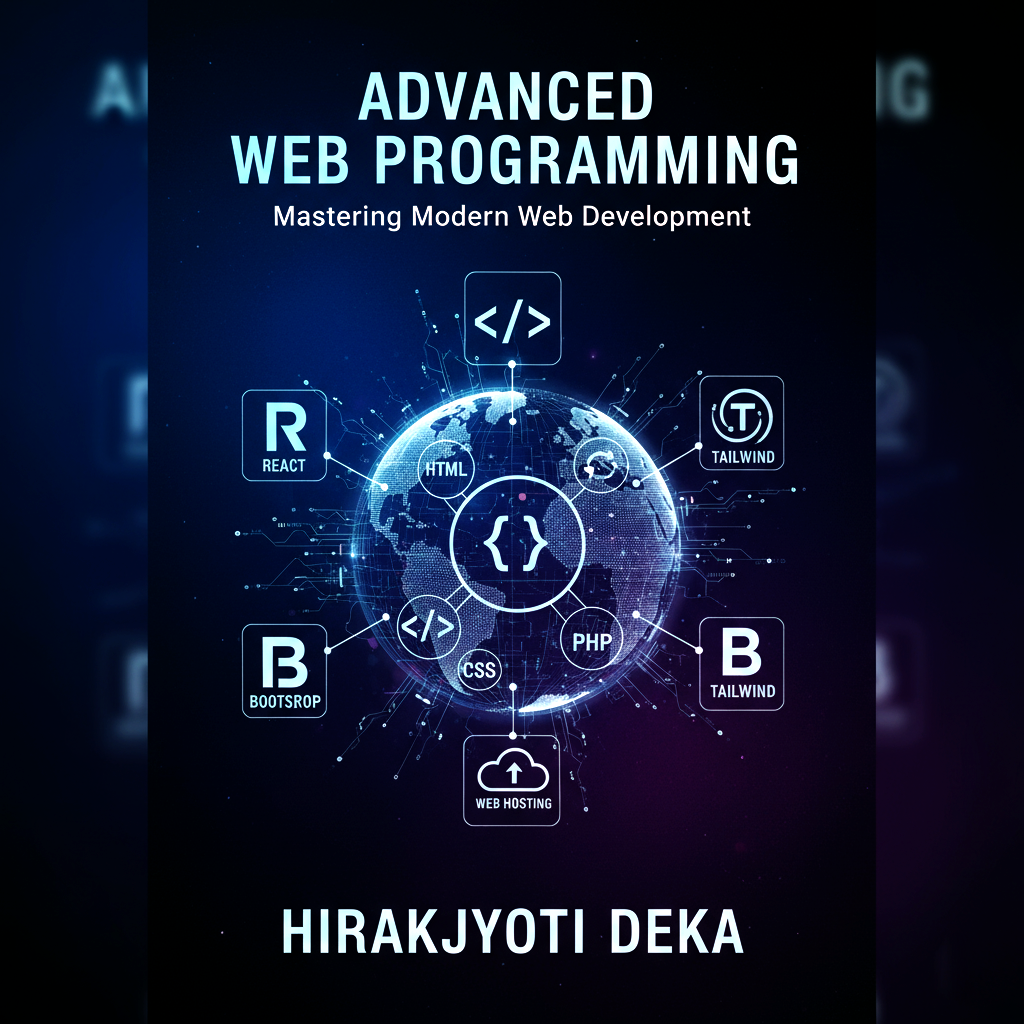
This course takes learners from solid web basics to advanced full stack development. It strengthens HTML structure and semantic markup for better SEO and accessibility. It builds strong CSS layout skills using flexbox, grid, and responsive design. It deepens JavaScript knowledge with async programming, APIs, and DOM control. It introduces PHP for server side logic, database work, authentication, and security. The course also explores hosting, deployment, version control, and modern web frameworks to prepare students for real world web development.
- Teacher: HIRAKJYOTI DEKA
Course Summary
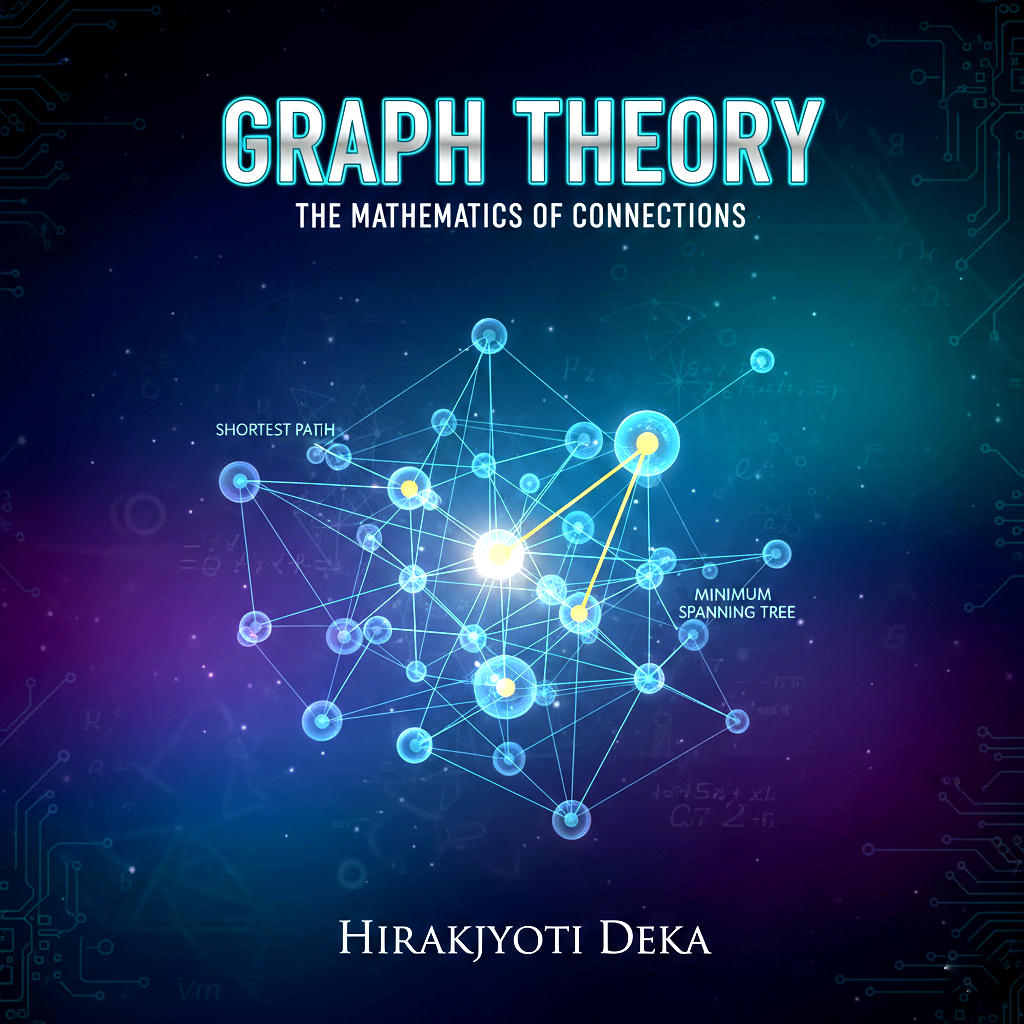
This course builds a strong base in graph theory and shows how it is used to solve real world problems in computing, networks, and optimization. Students learn key concepts, major algorithms, and classical problems using graph models.
Key Points
-
Understand core graph concepts like types of graphs, degree, connectivity, paths, cycles, and graph representations.
-
Apply traversal and shortest path algorithms such as BFS, DFS, Dijkstra, Bellman Ford, and Floyd Warshall.
-
Study trees, spanning trees, minimum spanning trees, and important tree based data structures.
-
Learn matching, coloring, vertex cover, and related theorems used in optimization problems.
-
Explore directed graphs, flow networks, and max flow algorithms.
-
Solve classical problems like Travelling Salesman, Chinese Postman, and network design using graph theory.
- Teacher: HIRAKJYOTI DEKA
📘 COURSE OVERVIEW
-
This course introduces the fundamental concepts and techniques of Artificial Intelligence (AI).
-
It covers problem-solving methods, search algorithms, knowledge representation, reasoning under uncertainty, natural language processing, and machine learning basics.
-
The course emphasizes both theoretical foundations and practical algorithms used in real-world AI systems.
-
Students will learn how intelligent systems make decisions, represent knowledge, handle uncertainty, and learn from data.
-
Ethical aspects and AI/ML tools are also discussed to prepare students for responsible AI development.
🎯 COURSE OUTCOMES (COs)
After completing this course, students will be able to:
CO1: Understand and explain the basic concepts, history, and applications of Artificial Intelligence.
CO2: Apply problem-solving techniques and search algorithms (BFS, DFS, A*, Minimax) to real-world problems.
CO3: Represent knowledge using logical and structured approaches such as First-Order Logic and Semantic Networks.
CO4: Apply reasoning techniques under uncertainty using probabilistic and Bayesian methods.
CO5: Understand Natural Language Processing basics and parsing techniques.
CO6: Implement and evaluate basic Machine Learning algorithms such as Linear Regression, k-NN, Decision Trees, and K-Means.
CO7: Analyze AI tools, applications, and ethical issues in AI systems.
📚 UNIT-WISE DESCRIPTION
🧠 UNIT 1: Introduction to Artificial Intelligence
-
Definition and goals of Artificial Intelligence
-
History and evolution of AI
-
Applications of AI in various domains (healthcare, robotics, finance, etc.)
-
Turing Test and evaluation of machine intelligence
-
Rational Agent approach to AI
-
Structure and behavior of Intelligent Agents
-
Types of environments (deterministic, stochastic, static, dynamic)
🔍 UNIT 2: Problem Solving and Searching Techniques
-
Problem characteristics and formulation
-
State space representation
-
Production systems and control strategies
-
Uninformed search techniques:
-
Breadth-First Search (BFS)
-
Depth-First Search (DFS)
-
Hill Climbing
-
-
Heuristic search techniques:
-
Best-First Search
-
A* Algorithm
-
-
Constraint Satisfaction Problems (CSP)
-
Means-End Analysis
-
Introduction to Game Playing
-
Minimax Algorithm
-
Alpha-Beta Pruning
🧩 UNIT 3: Knowledge Representation
-
Introduction to Knowledge Representation
-
First-Order Predicate Logic (FOPL)
-
Resolution Principle
-
Unification
-
Semantic Networks
-
Conceptual Dependencies
-
Frames and Scripts
-
Production Rules
-
Conceptual Graphs
-
Programming in Logic using PROLOG
🎲 UNIT 4: Dealing with Uncertainty and Inconsistencies
-
Truth Maintenance Systems
-
Default Reasoning
-
Probabilistic Reasoning
-
Bayesian Probabilistic Inference
-
Bayes’ Theorem and Applications
-
Possible World Representations
💬 UNIT 5: Understanding Natural Languages
-
Introduction to Natural Language Processing (NLP)
-
Parsing Techniques
-
Context-Free Grammars (CFG)
-
Transformational Grammars
-
Recursive Transition Networks (RTN)
-
Augmented Transition Networks (ATN)
🤖 UNIT 6: Machine Learning Fundamentals
-
Introduction to Machine Learning
-
Types of Machine Learning:
-
Supervised Learning
-
Unsupervised Learning
-
Reinforcement Learning
-
-
Supervised Algorithms:
-
Linear Regression
-
Logistic Regression
-
k-Nearest Neighbors (k-NN)
-
Decision Trees
-
-
Unsupervised Algorithms:
-
K-Means Clustering
-
-
Model Evaluation Metrics:
-
Accuracy
-
Precision
-
Recall
-
🛠 UNIT 7: AI/ML Tools, Applications and Ethics
-
AI and ML Development Tools
-
Applications of AI in Industry
-
Ethical Issues in AI
-
Bias in AI Systems
-
Data Privacy and Security
-
Responsible AI Practices
- Teacher: Sintu Barman
The course Object Oriented Programming through C++ is designed to introduce students to the fundamental concepts and principles of object-oriented programming and their application using the C++ programming language. This course emphasizes the transition from procedural programming to object-oriented design, enabling students to develop modular, reusable, and maintainable software solutions.
Students will learn the syntax and structure of C++, including data types, control structures, functions, and memory management. The course focuses on core object-oriented concepts such as classes, objects, data abstraction, encapsulation, inheritance, and polymorphism. Advanced features of C++ such as function overloading, operator overloading, dynamic memory allocation, file handling, and exception handling are also covered.
Through a combination of theory and hands-on laboratory exercises, students will gain practical experience in designing and implementing real-world applications using object-oriented techniques. By the end of the course, learners will be able to analyze problems, design appropriate class structures, and develop efficient C++ programs following object-oriented best practices.
- Teacher: Hiren Deka
This course introduces fundamental concepts of digital logic including number systems, Boolean algebra, logic gates, combinational and sequential circuits. The course equips students with analytical and design skills required for understanding digital systems used in modern computers.
- Teacher: Site Owner
Course Overview
This course introduces learners to Python programming, progressing from fundamental concepts to object-oriented programming and commonly used libraries. The module emphasizes hands-on coding, problem-solving, and real-world applications, making it suitable for virtual learning environments.
Course Learning Outcomes
By the end of this course, learners will be able to:
-
Write and execute Python programs using correct syntax and structure
-
Use control statements and functions effectively
-
Implement Python data structures for problem-solving
-
Handle errors and exceptions gracefully
-
Perform file operations in Python
-
Apply object-oriented programming principles
-
Use popular Python libraries for data analysis and visualization
Module Structure
Unit 1: Introduction to Python Programming
Duration: 1 Week
Marks/Weightage: 7
Topics Covered:
-
Introduction to Python
-
Installing Python & IDE setup
-
Python Shell and script execution
-
Code indentation and syntax rules
-
Identifiers, keywords, literals
-
Data types and strings
-
Operators: Arithmetic, Relational, Logical, Assignment, Ternary, Bitwise
-
Increment & decrement operators
-
Input/output statements
-
Output formatting
Learning Activities:
-
Video lectures
-
Live demo: Installing Python
-
Practice quizzes
-
Simple coding exercises
Assessment:
-
Online MCQ quiz
-
Basic programming assignment
Unit 2: Control Statements and Functions
Duration: 1 Week
Marks/Weightage: 5
Topics Covered:
-
Conditional statements (if, elif, else)
-
Looping (for, while)
-
Control statements: break, continue, pass
-
Defining and calling functions
-
Function arguments & default arguments
-
Scope of variables
-
Function documentation (docstrings)
-
Lambda functions
-
map() function
Learning Activities:
-
Interactive coding labs
-
Problem-solving tasks
-
Peer discussion forum
Assessment:
-
Coding assignment
-
Short-answer quiz
Unit 3: Python Data Structures
Duration: 1 Week
Marks/Weightage: 5
Topics Covered:
-
Lists and nested lists
-
Lists as matrices
-
Tuples
-
Sets
-
Dictionaries
Learning Activities:
-
Visual explanations of data structures
-
Hands-on exercises
-
Mini-project: Data manipulation
Assessment:
-
Practical coding test
Unit 4: Exception Handling
Duration: 1 Week
Marks/Weightage: 5
Topics Covered:
-
Types of errors
-
try–except blocks
-
Handling multiple exceptions
-
Writing user-defined exceptions
Learning Activities:
-
Error-debugging exercises
-
Live troubleshooting session
Assessment:
-
Scenario-based coding task
Unit 5: File Handling
Duration: 1 Week
Marks/Weightage: 8
Topics Covered:
-
Reading files: read(), read(), readline(), readlines()
-
Writing files: write(), writelines()
-
File modes
-
File operations
-
Reading configuration files
-
Writing log files
Learning Activities:
-
Guided lab sessions
-
File-handling case studies
Assessment:
-
Practical assignment on file operations
Unit 6: Object-Oriented Programming (OOP) in Python
Duration: 1–2 Weeks
Marks/Weightage: 8
Topics Covered:
-
Classes and objects
-
Constructors
-
Instance and class variables
-
Methods
-
Inheritance
-
Polymorphism
-
Encapsulation
-
Abstraction
Learning Activities:
-
Concept animations
-
OOP-based coding exercises
-
Mini-project using OOP concepts
Assessment:
-
Coding project
-
Viva (online)
Unit 7: Introduction to Libraries in Python
Duration: 1 Week
Marks/Weightage: 7
Topics Covered:
-
NumPy – arrays and basic operations
-
Matplotlib – data visualization
-
OpenCV – basic image processing
-
Tkinter – GUI basics
Learning Activities:
-
Library demos
-
Visualization tasks
-
GUI mini-app
Assessment:
-
Library-based mini project
Final Assessment & Certification
-
Final Project: Real-world Python application
-
Online Examination
-
Certificate of Completion issued by Virtual Academy
Tools & Platforms
-
Learning Management System (LMS)
-
Python (IDLE / VS Code / Jupyter Notebook)
-
Auto-grading system
-
Discussion forums
-
Recorded + live sessions
- Teacher: Sintu Barman
- Teacher: Site Owner